
Fairfield County Court Records After Arrest
After a Fairfield County arrest, two records tracks can exist at the same time. The jail record covers custody, booking, classification, bond-hearing timing, and release status. The court record covers the charge as filed or maintained in Magistrate Court, Municipal Court, Family Court, or General Sessions. The Sixth Circuit Solicitor handles prosecutions for Chester, Fairfield, and Lancaster Counties, and the solicitor can amend, reduce, dismiss, indict, or proceed on charges that differ from the first booking description.
The custody side remains useful, especially when the person has just been booked or is still waiting on bond. For current jail status, use Fairfield County jail inmate records. For booking photos and photo-request limits, use Fairfield County jail mugshots. The court side belongs in the Fairfield County Public Index, clerk records, magistrate records, municipal records when available, and solicitor filings.
If a court records after arrest search does not match a current county jail record, check the custody system that fits the case. Sentenced state prisoners are searched through the SCDC public app or the SCDC information line at 1-866-727-2846. Federal custody goes through BOP or the U.S. Marshals Service, immigration custody goes through ICE ODLS, and release notifications can be checked through VINELink South Carolina.
Find Court Records After Arrest
The South Carolina Judicial Branch provides a case-records search page, and Fairfield County has its own Public Index URL. The Judicial Branch notes that cookies and JavaScript are required and that a pop-up exception may be needed for details. If no case number is known, search by party name. If bond paper, a ticket, a clerk notice, or a warrant lists a case number, search by case number first. Court records after a jail arrest may appear after booking, after the first appearance, or after the prosecutor files or updates charges.
- Use the jail or bond paperwork to gather the defendant name, arrest date, arresting agency, charge, and any case number.
- Open the South Carolina Judicial Branch case records search and choose Fairfield County.
- Search the Fairfield County Public Index by party name or case number.
- Open matching cases and compare the filed court charge with the jail booking charge.
- For lower-level traffic and criminal matters, check the Fairfield Magistrate or municipal court route if the Public Index does not show the case.
- For General Sessions charges, check Circuit Court records and the Sixth Circuit Solicitor.
- For older or missing files, call or visit the Clerk of Court.
The Fairfield County Public Index screenshot at the county Public Index search page shows the case-search interface used for many court records after an arrest.
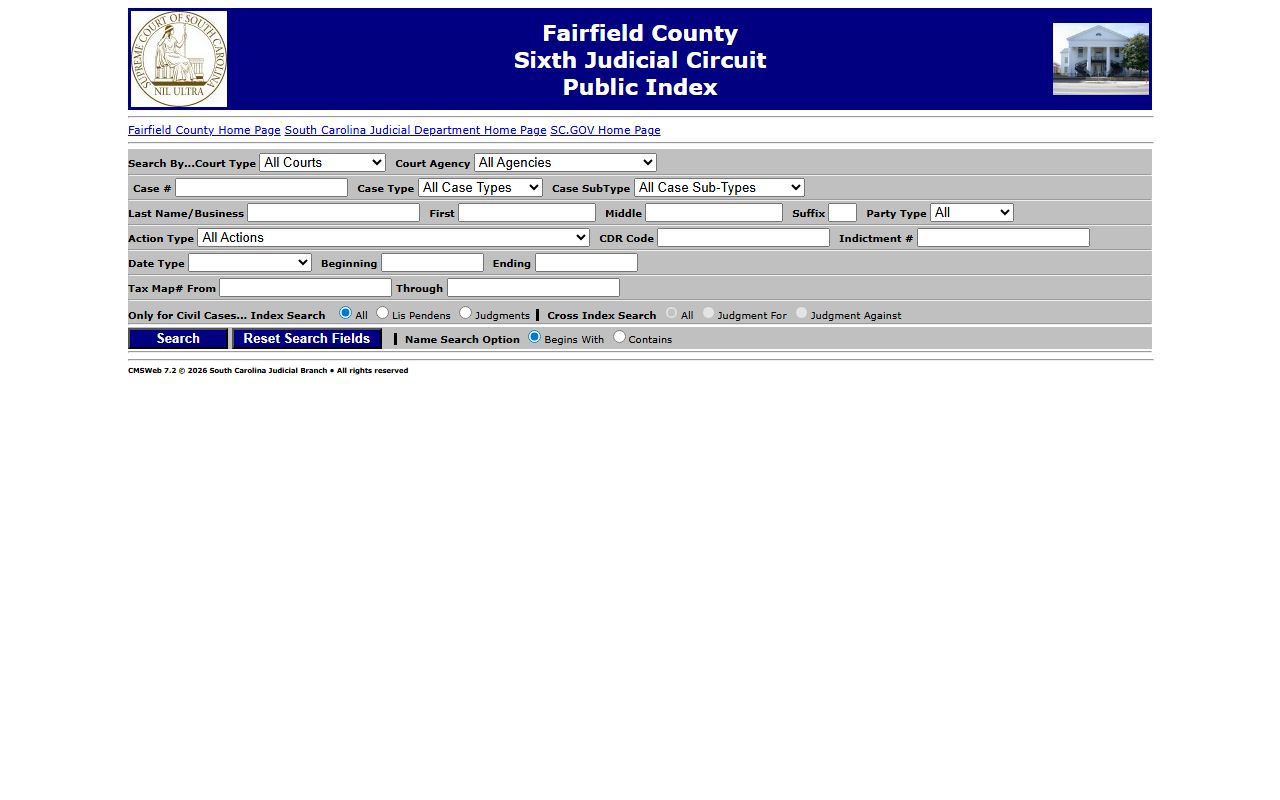
The Public Index is the main online route for matching a defendant name or case number to the court case that follows booking.
Fairfield County Court Search Fields
Available court search details are partial because the portal requires browser support for cookies and JavaScript. A search can fail for simple technical reasons, so use a standard browser and allow the case detail window if it is blocked. The Public Index is different from SLED CATCH. Public Index records show court filings and case events. SLED CATCH is a paid statewide criminal-history route.
| Field | Type | Use |
|---|---|---|
| County | Link or selection | Choose Fairfield County or use the Fairfield Public Index URL. |
| Case number | Text | Best when listed on bond paper, warrant, ticket, or clerk notice. |
| Party name | Text | Use defendant name when the case number is unknown. |
| Court type or index | Selection | Useful when searching circuit, family, magistrate, or municipal records. |
| Cookies and JavaScript | Browser requirement | Required by the Judicial Branch case-records page. |
Charges Filed After Arrest
The court charge can begin from different documents, depending on court level and case type. A complaint can start a lower-level criminal or traffic case. A prosecutor can proceed with an information in appropriate cases. A grand jury indictment is used for many serious General Sessions matters. The important point is that booking charges at the jail are not the final word. Prosecutors can file, amend, reduce, dismiss, or replace charges as the case develops.
| Document | Who Uses It | What It Means |
|---|---|---|
| Complaint | Officer, court, or prosecutor path | A charging paper often tied to lower-level criminal or traffic matters. |
| Information | Prosecutor | A prosecutor-filed charge document where allowed by South Carolina procedure. |
| Indictment | Grand jury and solicitor | A formal charge route common in serious General Sessions cases. |
Fairfield County Charge Status
Charge status language can be short but powerful. Pending means the case is not resolved. Dismissed means the charge is not proceeding in that court record. Nolle prosequi means the prosecutor has decided not to prosecute that charge. Amended or reduced means the charge changed. Disposition means the outcome. A conviction means guilt was established through plea, verdict, or other court result. An arrest or booking by itself is not a conviction.
| Status | Plain Meaning |
|---|---|
| Pending | The court case or charge remains unresolved. |
| Amended or reduced | The filed charge changed from an earlier charge description. |
| Dismissed | The charge is not proceeding in that court record. |
| Nolle prosequi | The solicitor chose not to prosecute that charge. |
| Disposition | The final or current outcome shown in the court record. |
| Conviction | A court result after plea, verdict, or other legal finding, not just an arrest. |
Fairfield County Court Contacts
The Fairfield County Clerk of Court is the local court-record fallback for circuit-level records and older filings. The county clerk page lists P.O. Drawer 299, Winnsboro, SC 29180, phone 803-712-6526, fax 803-712-1506, and office hours Monday through Friday, 9AM to 5PM. The South Carolina Judicial Branch profile names Dorothy Boyd Belton as clerk. Research notes say she was elected November 5, 2024 and began January 1, 2025.
Fairfield Magistrate Court is at 115-B South Congress Street in Winnsboro, with phone 803-635-4525 and fax 803-635-5717. The county magistrate page says magistrates mainly handle criminal and traffic offenses with a maximum fine of $500 or 30 days in jail, plus state assessments. A defendant must appear on the date and time shown on the ticket or bond paper. If traffic bond is mailed instead of appearing, the county page calls for money order, cashier's check, or bank-certified check payable to Fairfield County Traffic Court.
Fairfield County Clerk of Court
P.O. Drawer 299
Winnsboro, SC 29180
803-712-6526
Office hours: Monday-Friday, 9AM-5PM
Fairfield Magistrate Court
115-B South Congress Street
Winnsboro, SC 29180
803-635-4525
Criminal and traffic matters within magistrate jurisdiction
Sixth Circuit Solicitor Records
South Carolina uses the term solicitor for the elected prosecutor. Fairfield County is part of the Sixth Judicial Circuit with Chester and Lancaster Counties. The official solicitor site names Randy E. Newman Jr. as Solicitor, and the staff page lists Deputy Solicitor Melissa McGinnis and assistant solicitors. The solicitor handles the prosecution side of criminal charges after arrest, especially General Sessions cases.
The detention center page lists a local solicitor office reference at 101 S Congress Street in Winnsboro and phone 803-712-6526. The solicitor's site also shows general phone 803-416-9367. Treat those as routing points, not exclusive proof that one number handles every Fairfield prosecution question. For court records after a jail arrest, the Public Index and Clerk of Court should usually be checked before calling the solicitor about a status question.
The image from the Sixth Circuit Solicitor site documents the prosecutor office serving Fairfield County.
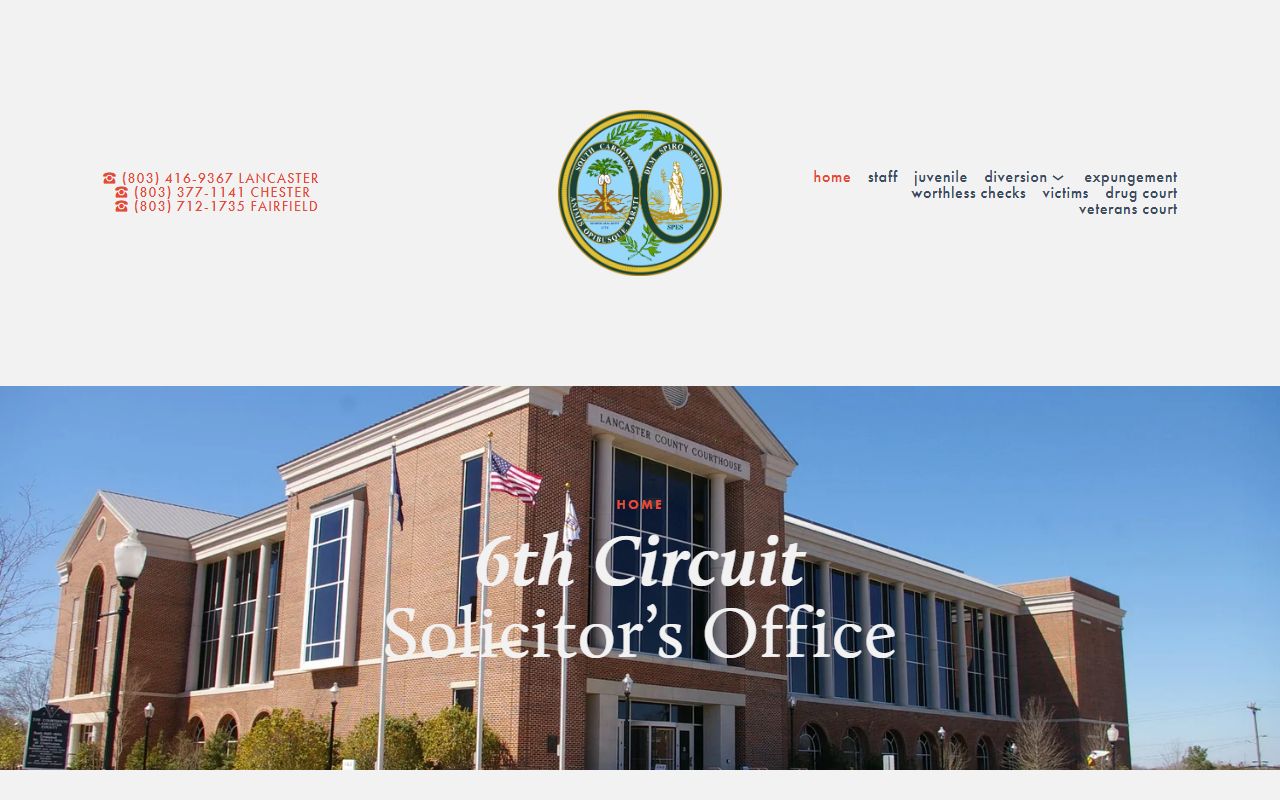
The solicitor source matters because formal prosecution charges can differ from the jail's first booking description.
Bond Records After Arrest
Bond hearings are local and specific in Fairfield County. The county bond page says hearings are held at the detention center seven days a week. Winnsboro Department of Public Safety charges are heard at 8:00 AM and 4:00 PM. Charges from all other Fairfield County law-enforcement agencies are heard at 9:00 AM and 5:00 PM. The judge decides release while the case is pending and considers flight risk and danger to the public. The hearing does not decide guilt.
| Bond Type | How It Works |
|---|---|
| Cash bond | Money is paid directly if the court permits that type of release. |
| Surety bond | A licensed bonding agency posts the bond under court and jail rules. |
| Personal recognizance | Release based on a written promise if the judge orders it. |
| No-bond hold | Release is not available by paying money on that charge or hold. |
| Other-agency hold | An out-of-county, SCDC, ICE, or federal hold may block release after local bond. |
Warrants Before Court Records
No official Fairfield County online active-warrant search was found. The Fairfield County Sheriff's Office, led by Sheriff Will Montgomery, identifies Civil/Warrants as the division responsible for serving all warrants and civil papers within the jurisdiction. The sheriff office main phone is 803-635-4141, and the office is at 250 N Walnut Street in Winnsboro. Magistrate Court and Clerk of Court records can also show warrant-related case activity such as failure to appear.
An arrest warrant authorizes arrest for an alleged offense. A bench warrant is often issued after failure to appear or violation of a court order. A search warrant authorizes a search and is not a custody lookup tool. A fugitive or other-agency warrant can create a hold that keeps a person jailed after a local bond is set. If a warrant leads to booking, track custody through the detention center and court records through the Public Index or court clerk.
Charges vs Convictions
A Fairfield County arrest can produce a booking record and a court charge, but neither one is the same as a conviction. A charge is an accusation pending in court. A conviction follows a plea, verdict, or other court result that establishes guilt. Background checks, employment decisions, housing decisions, and other regulated decisions may be governed by laws outside the court file itself.
| Point | Charge | Conviction |
|---|---|---|
| Stage | Filed accusation after arrest or investigation | Final or adjudicated result |
| Proof | Not proof of guilt | Based on plea, verdict, or legal finding |
| Record location | Public Index, magistrate, municipal, or clerk file | Disposition in the court record and sometimes SLED history |
Sealed and Expunged Records
South Carolina court and public-access rules can limit what remains visible after some case outcomes. S.C. Code 22-5 contains magistrate and municipal expungement provisions, while South Carolina FOIA exemptions can limit certain law-enforcement and privacy-sensitive records. An expungement is a court process to seal or destroy eligible arrest or charge records. It is not automatic for every dismissal, and it does not promise that every copied record already posted elsewhere will vanish at once.
| Point | Sealed | Expunged |
|---|---|---|
| Public view | Hidden or restricted from normal public access | Destroyed, removed, or treated under the expungement order |
| Source | Court order or statutory access limit | Eligibility and court process under South Carolina law |
| Next step | Ask the court or clerk about the order | Use the formal expungement process and provide the order where needed |
Note: SLED CATCH is a paid statewide criminal-history channel and is not the same as a county jail roster or court docket.